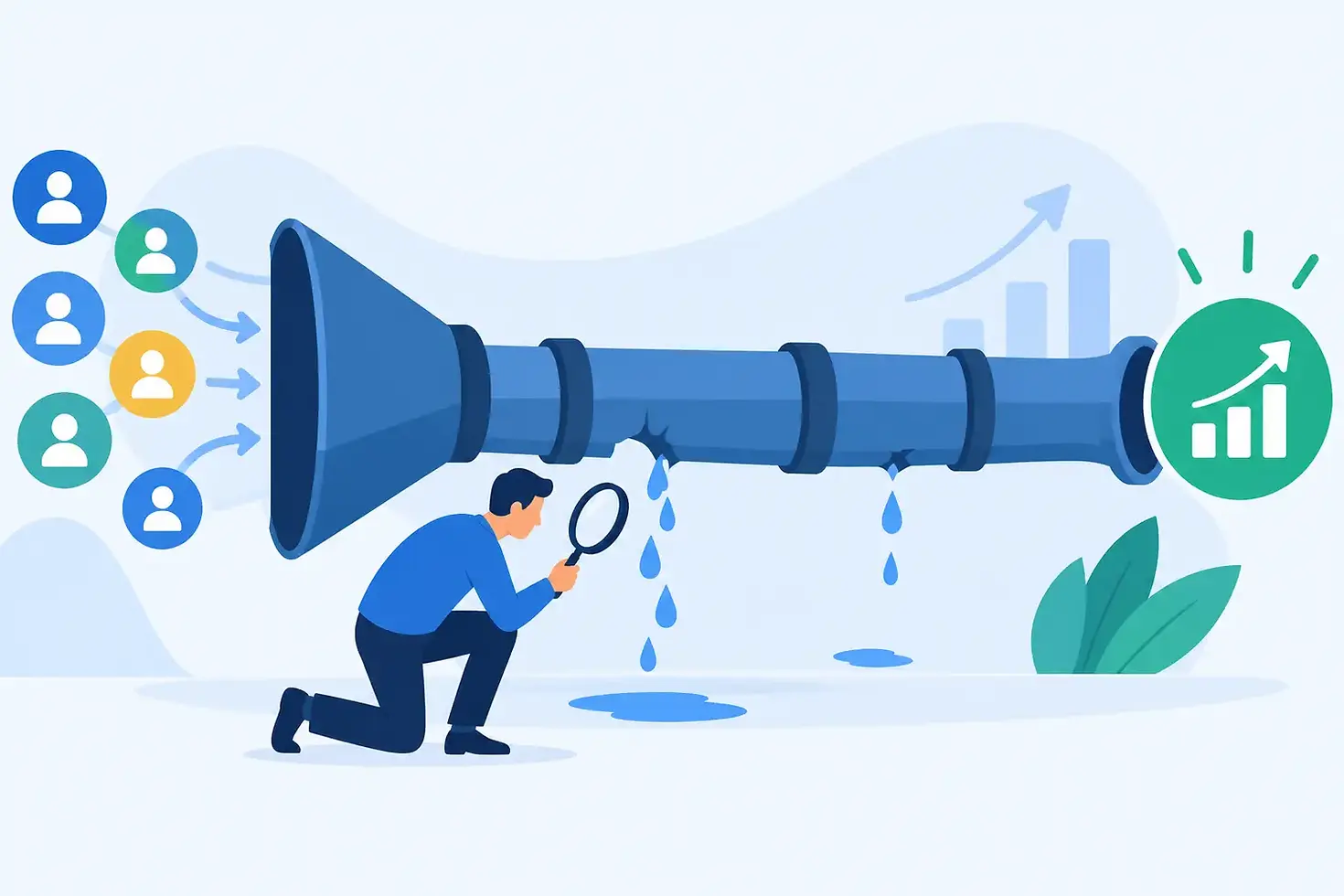
Sales Pipeline Optimization Guide That Finds Leaks
A full calendar, steady website traffic, and a healthy-looking CRM can create a comforting story: demand is coming in, so growth must be on track. But if too few inquiries become customers, more activity is not the answer. It is often camouflage. This sales pipeline optimization guide is about finding the points where a credible prospect hesitates, gets confused, loses momentum, or simply forgets to continue.
Most pipeline problems are not caused by one dramatic failure. They are caused by small doubts that stack up. A visitor cannot quickly tell whether you serve companies like theirs. A form asks for too much. A sales rep follows up three days later with a generic message. A proposal describes deliverables but leaves the buyer to connect them to a business outcome.
None of those issues looks catastrophic in isolation. Together, they create a pipeline that appears busy while quietly leaking qualified opportunities.
More Leads Will Not Fix a Leaky Pipeline
Founders often respond to a slow sales pipeline by asking for more traffic, more ads, more content, or more outbound activity. Those can be valid investments when demand is genuinely thin. But sending more people into an unclear journey does not solve the underlying problem. It increases the cost of learning the same lesson.
Start with the evidence already available. Look at where prospects stop moving forward: website visit to inquiry, inquiry to booked conversation, first conversation to proposal, proposal to decision, or decision to closed business. The largest drop-off is not automatically the first thing to fix, but it tells you where to investigate.
A 70% drop between proposal and close may signal weak qualification before the proposal stage. A low website-to-inquiry rate may reflect poor traffic quality, but it may also mean visitors cannot understand your offer, trust your claims, or see a logical next step. Numbers identify the symptom. Reviewing the buyer experience helps explain the cause.
Do not treat every abandoned lead as a lost sale. Some were never a fit. The goal is not to pressure every contact through the pipeline. The goal is to make it easier for the right people to evaluate, engage, and decide.
Start With the Buyer’s First Doubts
A sales pipeline begins before someone fills out a form. It starts when a first-time visitor encounters your business and tries to answer a few practical questions:
What does this company actually help with?
Is this meant for a business like mine?
Why should I believe they can deliver?
What happens if I take the next step?
If your website makes visitors work to answer these questions, sales is already inheriting a harder job. The visitor may submit an inquiry, but they arrive uncertain about the problem you solve, your process, or the level of investment involved. That uncertainty tends to show up later as vague conversations, price resistance, and stalled proposals.
Review your highest-intent pages as if you have never heard of your company. Your homepage, service pages, case studies, contact page, booking flow, and thank-you pages should create one connected argument. The message should not merely describe your capabilities. It should help a skeptical prospect recognize their problem, understand your approach, and see why continuing makes sense.
Specificity matters here. “We deliver tailored solutions” gives a buyer nothing to assess. “We help established service businesses find and fix the website and follow-up friction that costs them qualified inquiries” creates a clearer starting point. The second statement will not appeal to everyone. That is part of its value.
Sales Pipeline Optimization Guide: Diagnose Before You Redesign
When conversion is weak, businesses often jump to a full website redesign or a new CRM. Sometimes that is warranted. Often, it is an expensive way to avoid diagnosis.
Before changing platforms, map the existing journey from attention to sale. Include the handoffs, not just the stages in your CRM. For example, a prospect may see an ad, read a service page, visit a pricing page, submit a form, receive an automated confirmation, wait for a reply, book a call, receive a recap, review a proposal, and discuss it internally. Every step either reduces uncertainty or adds to it.
For each stage, ask three questions: What is the prospect trying to decide here? What evidence do they have? What friction could prevent the next action?
A useful diagnosis separates visible evidence from plausible hypotheses. Evidence might include recordings that show visitors repeatedly abandoning a form field, CRM data showing slow response times, or call notes revealing the same objection across deals. A hypothesis might be that your offer sounds too broad or your proposal is difficult to compare against doing nothing. Hypotheses are still useful, but they should be tested rather than presented as fact.
This distinction protects you from a common optimization mistake: making many changes because they sound reasonable, then having no idea which change helped or hurt.
Fix the Highest-Value Friction First
Not every issue deserves equal attention. A slightly awkward button label is usually less consequential than an offer that is hard to understand or a follow-up process that lets warm leads go cold.
Prioritize fixes using three factors: the number of qualified people affected, the likely effect on a buying decision, and the effort needed to implement and measure the change. That framework keeps teams from spending weeks debating cosmetic details while a major source of hesitation remains untouched.
The highest-value fixes commonly fall into four areas:
Offer clarity: State who the offer is for, the problem it addresses, the outcome it is designed to support, and what is included. Buyers should not need a discovery call to understand the basics.
Trust and proof: Use proof that reduces the specific risk a buyer feels. Relevant examples, clear process explanations, credible testimonials, and honest constraints are more useful than generic claims of excellence.
Conversion paths: Make the next step obvious and proportionate to commitment. A visitor considering a complex service may not be ready to “buy now,” but they may be ready to request a diagnostic, book a fit call, or review a clear plan.
Follow-up discipline: Reply quickly, acknowledge the prospect’s stated situation, and provide a useful next step. A fast generic response is better than silence, but a relevant response is better than either.
There are trade-offs. Reducing a form from eight fields to three may lift inquiry volume while reducing lead context. Publishing pricing ranges may discourage bargain hunters but attract better-informed conversations. Adding qualification questions may lower total bookings but improve sales time spent with viable prospects. Choose the trade-off that improves meaningful opportunity quality, not the metric that looks best in a weekly report.
Treat Follow-Up as Part of the Product
Many established businesses do strong work for clients and weak work for prospects. The gap is often follow-up.
A prospect who requests information has not granted unlimited attention. If your response arrives late, reads like a template, or makes them repeat what they already shared, you are teaching them what it may feel like to work with you. That is not a minor operational detail. It is a conversion signal.
Set a practical response standard for high-intent inquiries. Then make the first reply useful. Reference their stated need, clarify what will happen next, and give them a reason to continue. If they do not respond, follow up with a message that adds context or addresses a likely question rather than simply asking whether they saw the last email.
The same principle applies after sales calls. A recap should make the buyer’s decision easier: their situation, the agreed priority, the recommended approach, the next step, and any open questions. If a proposal is sent without a clear decision process, it can become a polished document that disappears into an inbox.
Measure Movement, Not Just Activity
Pipeline optimization needs a small set of measures tied to actual progress. Website sessions, email opens, and total leads may provide context, but they do not tell you whether buying friction is improving.
Track conversion between meaningful stages, response time for qualified inquiries, source-to-close performance, sales cycle length, and the reasons opportunities are marked lost. Review these over a consistent period. One week can be noisy, particularly for businesses with longer sales cycles or lower deal volume.
Add qualitative review to the numbers. Listen to calls. Read inquiry messages. Review lost-deal notes for patterns, while recognizing that “price” often means something more specific: unclear value, weak differentiation, bad timing, insufficient trust, or an offer that did not fit the buyer’s situation.
When you make a change, document the hypothesis. For example: clarifying the target customer on the service page should increase qualified inquiry rate because visitors can identify themselves faster. Then compare the result against a reasonable baseline. You may not get perfect certainty, but you will build better judgment than you would by changing everything at once.
Keep the Pipeline Honest
A pipeline should help you make decisions, not help you feel optimistic. If deals sit in stages because no one wants to close them out, your forecast becomes fiction. Define what qualifies an opportunity to enter each stage, what evidence indicates real progress, and when a deal should be moved to closed lost or recycled for later follow-up.
This is not about becoming rigid. Complex sales require judgment, and real buyers rarely move in a neat straight line. It is about refusing to confuse hope with evidence.
The most useful improvement may be smaller than you expect: a clearer first screen, a more relevant confirmation email, a tighter qualification call, or a proposal that makes the commercial decision easier to explain internally. Fix the point where your best prospects hesitate next. Then watch what they do.


%20copy.webp)
Comments