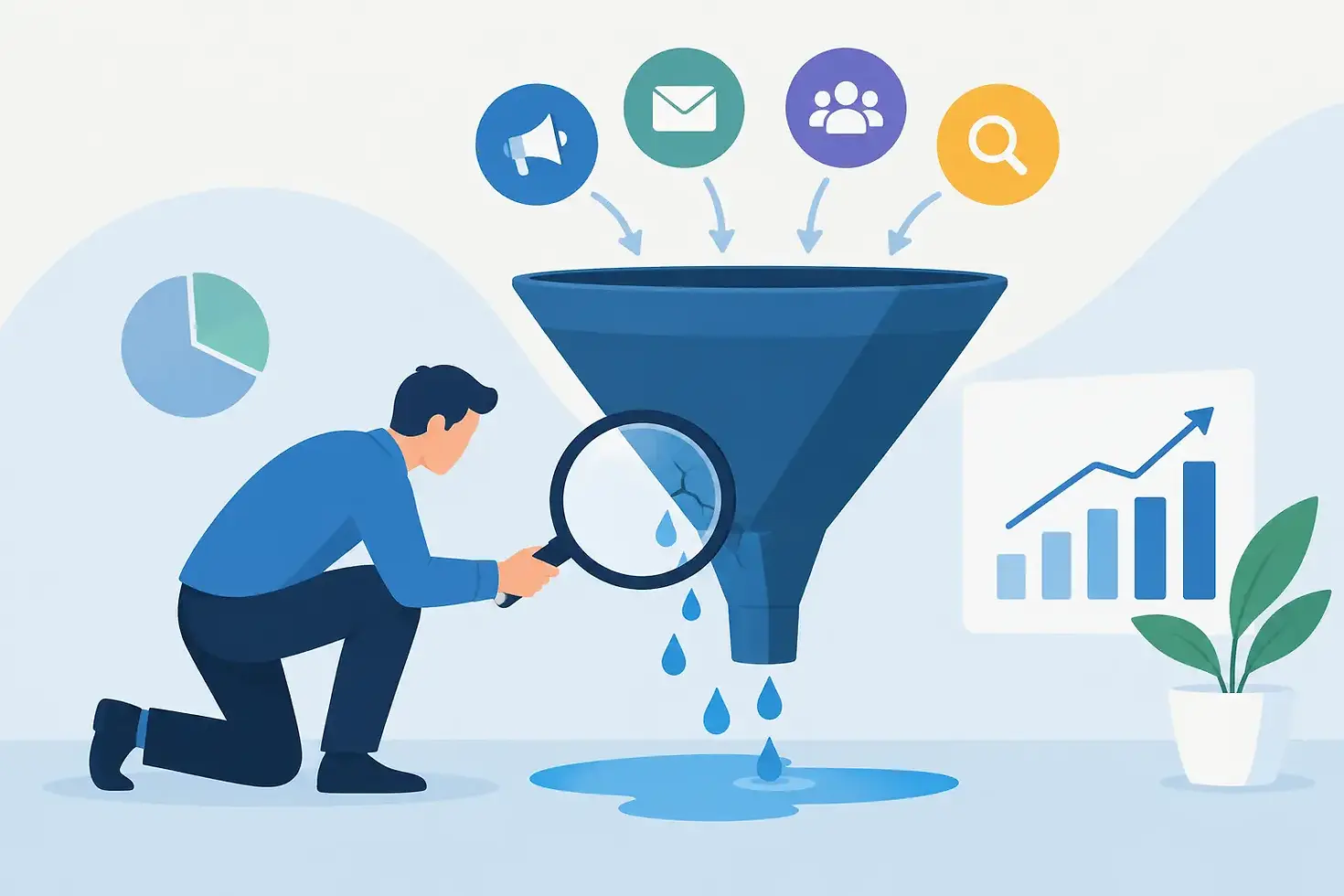
Marketing Efficiency Audit: Find the Leaks First
A marketing efficiency audit is not a report card for your marketing team. It is a way to find out why people who already know about your business are failing to take the next step.
That distinction matters. A founder sees steady site traffic, referrals, social engagement, or paid leads and assumes the problem is volume. But a first-time visitor does not experience your business as a traffic chart. They experience a series of decisions: What does this company actually do? Is this for someone like me? Can I trust them? Is this worth the effort? What happens if I reach out?
If those answers are unclear, more traffic simply creates more opportunities for people to leave.
What a Marketing Efficiency Audit Actually Measures
Marketing efficiency is the relationship between the attention you earn and the meaningful business outcomes that attention produces. Those outcomes might be qualified inquiries, booked consultations, quote requests, demo requests, purchases, or sales conversations that actually fit your business.
A useful audit follows the customer journey instead of reviewing marketing channels in isolation. It looks at what happens after someone sees an ad, gets a referral, clicks a search result, or lands on your homepage.
We are looking for friction, not just missing tactics. Friction is any point where a reasonable prospective customer hesitates, gets confused, loses confidence, or postpones action. It can be as obvious as a broken form. More often, it is a combination of smaller problems: vague positioning, generic service pages, proof that appears too late, a weak call to action, and no useful follow-up after a visitor leaves.
The goal is not to document every imperfection. Nearly every established business could produce a long list of website improvements. The goal is to identify the few problems most likely to affect buying decisions.
More Traffic Won't Fix a Weak Customer Journey
A professional-looking site can still underperform. Clean design is not the same as clear communication, and traffic is not the same as demand.
Consider a visitor referred by a trusted colleague. They arrive with interest, but the homepage opens with a broad statement about quality, innovation, or personalized service. They cannot quickly tell what you sell, who it is for, or why your approach is different. They click around, find a list of services, then leave without contacting you.
That is not necessarily a lead-generation problem. The referral did its job. The site failed to carry the conversation forward.
The same applies to paid campaigns. Ads can create awareness and attract clicks, but they cannot compensate for a landing page that makes visitors work to understand the offer. They also cannot fix a sales follow-up process that lets interested leads sit unanswered for two days.
An audit helps separate acquisition problems from conversion problems. Sometimes you do need better traffic. If your visitors are largely outside your market, your offer is reaching the wrong audience, or your channels are producing poor-fit leads, conversion changes alone will have limits. But many founder-led businesses have not earned the right to spend more on acquisition yet. They have leakage in the journey they already own.
Where a Marketing Efficiency Audit Looks
The first impression
The first screen of your website has a difficult job. It needs to orient a skeptical visitor quickly. Within a few seconds, they should be able to understand the core offer, recognize whether it fits their situation, and see a credible next step.
This does not mean your headline must explain every detail. It means it should not force visitors to translate brand language into practical meaning. Phrases like "solutions for growth" or "built around your success" sound polished but tell a first-time customer very little.
We look for visible evidence: whether the offer is stated plainly, whether the audience is identifiable, whether the next action is clear, and whether the page gives people a reason to keep reading.
The offer and decision path
Many sites describe capabilities when prospects need help choosing. A visitor may see ten services, several industries, and a page full of internal terminology. What they cannot see is which option applies to their problem, how the engagement works, or what result they can reasonably expect.
An efficient journey reduces unnecessary decision-making. It gives visitors enough context to identify themselves, understand the path forward, and take an appropriate action. That action may be a consultation, a quote request, an assessment, or a purchase. It depends on the complexity and price of the offer.
For high-consideration services, asking for an immediate purchase may be unrealistic. For a straightforward service with clear pricing, hiding the price behind a call might create needless resistance. The right path is not universal. It should match the buyer's level of risk, knowledge, and urgency.
Trust at the moment it is needed
Trust signals work best when they answer a specific concern. A testimonial that says "great team" may be nice to have, but it does little for a buyer wondering whether you understand their industry, deliver on time, or handle a complicated project.
Useful proof is concrete. It can show the kind of clients you serve, the problems you solve, the process you use, the work you have delivered, or the outcomes customers were willing to share. Claims should be supported, not inflated.
An audit checks whether proof appears near the decisions it is meant to support. A case study buried in a resources section may not help someone deciding whether to submit a form. A credibility logo at the bottom of the homepage may not answer the concern raised on a service page.
The conversion point
Forms, booking tools, checkout pages, and contact options are where hesitation becomes measurable. Small details matter here: too many required fields, unclear response expectations, a generic button label, confusing error messages, or a phone number that leads nowhere after hours.
But the form itself is rarely the whole problem. If few visitors reach it, the issue may be earlier in the journey. If people start but abandon it, the request may feel too demanding or unclear. If submissions are high but qualified conversations are low, the offer or screening process may need attention.
This is why a marketing efficiency audit should connect behavior to context rather than treating every lower number as a form problem.
Follow-up after the click
The customer journey does not end when someone submits a form. Yet many businesses spend heavily to create inquiries and then treat response time, email confirmations, and lead handoffs as operational details.
They are conversion details.
A prospect who has just raised their hand is comparing you against expectations set by every other business they have dealt with. A quick, useful acknowledgment can sustain momentum. Silence, a generic auto-reply, or a slow follow-up can turn genuine interest into a forgotten task.
Review what a person receives, when they receive it, who owns the response, and what happens if they do not book or buy immediately. The purpose is not to automate every interaction. It is to make sure interest does not disappear because the next step is undefined.
How to Prioritize What You Find
An audit becomes expensive theater when every issue receives equal weight. A different button color is not as consequential as a homepage that obscures the offer. A full redesign is not automatically the answer when clearer page structure, stronger proof, and a better inquiry path would address the actual friction.
Prioritize each finding using three questions: How close is this issue to a meaningful buying decision? How many relevant prospects are likely to encounter it? What evidence suggests it is creating friction?
Evidence can include analytics, session recordings, form data, call notes, sales objections, heatmaps, customer interviews, and plain on-page observation. Not every finding will have perfect data. A confusing headline can be visible without a dashboard proving it. In those cases, label the point honestly as a hypothesis and test or validate it.
The highest-priority fixes are usually both visible and consequential. They clarify the offer, reduce uncertainty, strengthen decision-stage proof, or remove a barrier from the path to inquiry. Start there before rebuilding pages that are merely dated or experimenting with new campaigns.
Turn the Audit Into Measurable Learning
A good audit should lead to a short, ordered action plan. Each recommendation needs a reason, an owner, and a way to observe whether the change helped.
Do not measure success with page views alone. Watch the actions that represent progress for your business: qualified inquiries, booked meetings, completed checkouts, request-to-close rate, or sales velocity. If a clearer service page produces fewer form fills but more qualified conversations, that may be an improvement, not a failure.
Change one major variable at a time when practical. If you rewrite the homepage, replace the offer, redesign the form, and launch new ads in the same week, you will have a hard time learning what caused the result. Speed matters, but so does preserving enough clarity to make better decisions next time.
At Sky Feather, our Revenue Leak Scan starts with this principle: before asking how to get more people to your site, ask what a qualified stranger encounters when they arrive. The answer often points to a smaller, more practical fix than a new campaign.
Your marketing does not need to be perfect to become more efficient. It needs to make the next decision easier for the right customer. Find where that decision currently gets harder, fix the most consequential leak first, and let the journey earn more from the attention you already have.


%20copy.webp)
Comments